Introduction
Renting an office, hiring staff, buying equipment — the traditional business checklist can scare off anyone with a limited budget. The good news is that some of the most profitable businesses today start from a spare room or a kitchen table. Home based business ideas have exploded in popularity precisely because they cut overhead costs to almost zero, letting more of your revenue turn into actual profit. This guide covers home based business ideas specifically chosen for high margins, so your effort translates into real income, not just busy work.
Why Home-Based Businesses Can Have Higher Margins
Without rent, commercial utilities, or a commute, a much larger share of revenue drops straight to profit — often 20-40% higher margins than a comparable business with a physical storefront.
Quick answer: Home based businesses have higher profit margins mainly because they eliminate rent, commuting, and overhead staff costs, letting most revenue convert directly into profit.
This doesn’t mean less effort is required — it means the effort you put in is more efficiently converted into income, rather than being absorbed by fixed costs.
Freelance Consulting Based on Professional Expertise
If you have specialized professional experience — accounting, HR, marketing, legal advisory — consulting from home lets you charge premium rates with almost no overhead beyond your laptop and time.
[link to related guide on freelance pricing strategies here]
A former corporate HR manager, for instance, built a home-based HR consulting practice serving small businesses that couldn’t afford a full-time HR head — charging a fraction of a full-time salary while working with multiple clients simultaneously.
Homemade Food and Baked Goods Business
Food-based home based business ideas — baking, tiffin services, or specialty snacks — have relatively low ingredient costs relative to selling price, especially for niche or premium products.
Key considerations before starting:
- Local FSSAI licensing requirements for home food businesses
- Starting with a narrow menu (3-5 items) rather than a broad one
- Building initial customers through local community groups and word-of-mouth
- Pricing based on both ingredient cost and time invested, not just materials
Online Tutoring and Skill-Based Coaching
Tutoring — academic subjects, music, language, or professional skills like coding — has almost zero material cost once you have an internet connection, making margins exceptionally high.
- Pick a subject where you have genuine, demonstrable expertise
- Start with one-on-one sessions before building group classes
- Use video calls and shared digital whiteboards for delivery
- Gradually create recorded content to sell alongside live sessions
Handmade Products and Craft Businesses
Handmade goods — jewelry, candles, home décor, or personalized gifts — can command premium pricing for uniqueness, especially when sold through the right channels.
Quick answer: Handmade product businesses achieve high margins by charging for craftsmanship and uniqueness rather than competing on mass-manufactured pricing, especially through direct-to-customer online sales.
Selling directly through social media or your own online store, rather than through resellers, protects your margins by cutting out middlemen who would otherwise take a cut.
Digital Services: Content Writing, Design, and Virtual Assistance
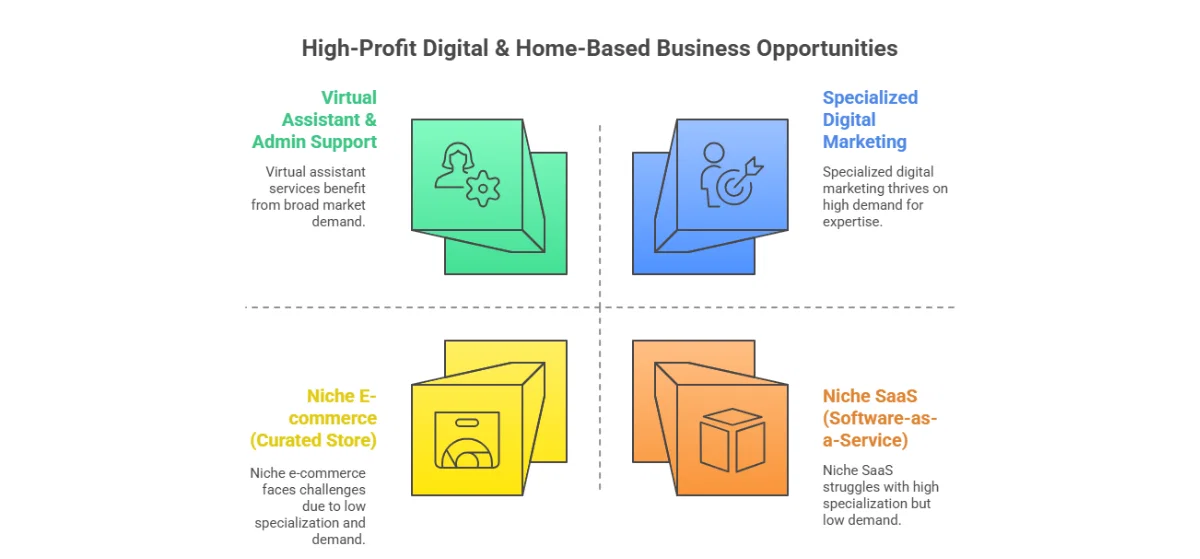
Digital services delivered entirely online — writing, graphic design, virtual assistance, bookkeeping — require no inventory and can be delivered to clients anywhere, keeping costs minimal.
A home-based virtual assistant service, for example, can serve clients across multiple time zones with just a laptop, charging hourly or retainer rates that scale as you take on more clients or hire subcontractors.
Home-Based E-Commerce for Niche Products
Running a small, niche e-commerce business from home — sourcing or making specific products and selling through online marketplaces — avoids the cost of physical retail space entirely.
Tips for keeping margins high:
- Focus on a narrow niche rather than competing broadly
- Negotiate better rates with suppliers as order volume grows
- Use social proof (reviews, testimonials) to justify premium pricing over generic competitors
Managing Taxes and Legal Requirements for Home Businesses
Even a home-based business needs proper registration, tax compliance, and, in some cases, local licensing — skipping this can create bigger problems later as the business grows.
Basic steps to cover:
- Register under the appropriate business structure (sole proprietorship, LLP, etc.)
- Maintain separate business banking to simplify accounting
- Track all expenses for accurate tax filing and deductions
- Check for any local municipal permits required for home-based commercial activity
FAQ
Which home based business idea has the lowest startup cost? Freelance consulting and digital services typically have the lowest startup costs, since they require only a laptop and internet connection rather than physical inventory.
Do home based businesses need a separate business license? Requirements vary by location and business type, but most home businesses still need basic registration and, for food businesses, specific health and safety licenses.
How much can a home based business realistically earn? Earnings vary widely by niche and effort, but many home-based consultants and service providers earn comparable to or more than a full-time salary once established.
Is it hard to market a home based business without a storefront? Not necessarily — social media, local community groups, and word-of-mouth referrals are often more effective and cost less than traditional storefront advertising.
Can I run a home based food business without a commercial kitchen? Many regions allow home food businesses under specific licensing (like FSSAI in India) with basic hygiene standards, though rules vary, so checking local regulations first is essential.
What’s the biggest risk with home based businesses? The biggest risk is underpricing services or products since there’s no rent pressure to justify higher prices, which can undervalue the actual time and skill invested.
Conclusion
Home based business ideas offer a genuine path to high-margin income without the overhead of a traditional storefront — but success still depends on choosing a niche, pricing correctly, and building trust with customers directly. Whether it’s consulting, handmade products, or digital services, the businesses on this list share one thing in common: low fixed costs and high potential margins. Pick the idea that best matches your existing skills, and start with a small, testable version before scaling further.