You’ve built a website, maybe even written a few blog posts, but Google traffic is basically zero. If this sounds familiar, you’re not alone — most beginners assume SEO is some complex technical black box reserved for experts. The truth is, SEO for beginners in India doesn’t require coding skills or years of experience. It requires understanding a handful of core principles and applying them consistently. This guide breaks down exactly what actually moves the needle, without the confusing jargon most SEO articles throw at you.
What SEO Actually Means (In Plain English)
SEO for beginners in India starts with understanding that SEO simply means making your website easier for Google to understand and trust, so it shows your pages to people searching for relevant things.
Quick Answer: SEO (Search Engine Optimization) is the process of improving your website so it ranks higher in Google search results for relevant keywords. It combines content quality, technical setup, and credibility signals like backlinks to help Google trust and rank your site.
There’s no secret trick or shortcut — SEO is essentially about creating genuinely useful content and making sure Google can find, read, and trust it.
Keyword Research: The Foundation of SEO
Before writing a single word of content, you need to know what your audience is actually searching for. Guessing keywords is one of the biggest beginner mistakes.
Free tools to get started:
- Google Keyword Planner – Free with a Google Ads account, shows search volume
- Google Autocomplete – Type your topic and see suggested searches
- AnswerThePublic – Shows common questions people ask around a topic
- Google’s “People Also Ask” section – Great for content ideas
Look for keywords with decent search volume but manageable competition — for a new website, targeting “best CRM software” is nearly impossible, but “best CRM software for small business India” is far more achievable.
On-Page SEO: Optimizing Individual Pages
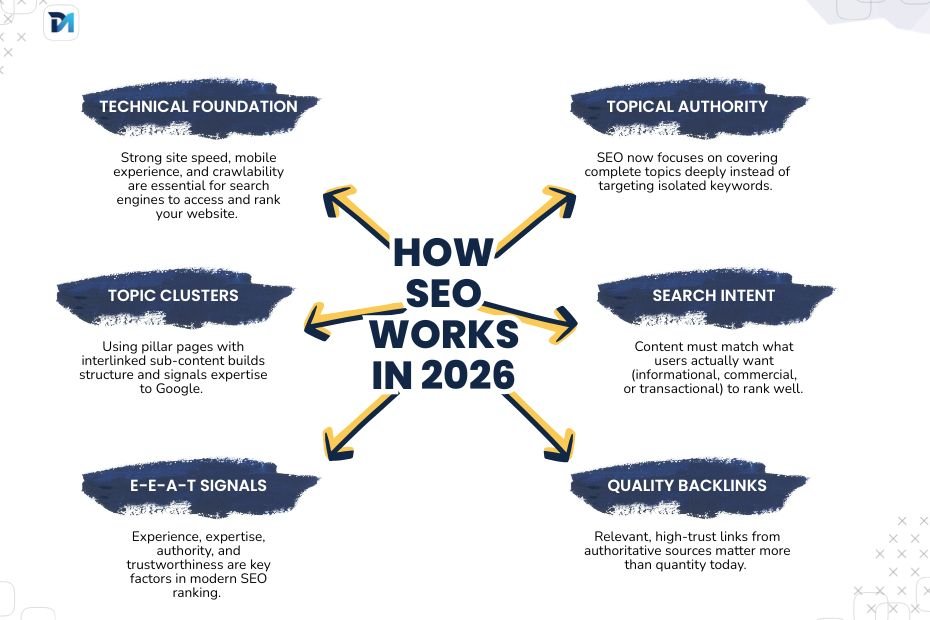
Once you know your target keyword, on-page SEO ensures Google understands what each page is about.
Key elements to optimize on every page:
- Title tag – Include your primary keyword naturally, keep under 60 characters
- Meta description – A compelling 150-160 character summary that encourages clicks
- H1 and H2 headings – Use your keyword naturally in headings
- URL slug – Short, keyword-inclusive, no unnecessary words
- Image alt text – Describe images while naturally including relevant keywords
Each page should target one primary keyword, with related terms woven in naturally throughout the content.
Content Quality Matters More Than Ever
Google’s algorithm has gotten significantly better at identifying genuinely helpful content versus thin, keyword-stuffed pages built purely for ranking.
Quick Answer: Google prioritizes content that thoroughly answers a searcher’s question with genuine expertise and detail. Thin, generic content — even with perfect keyword usage — tends to rank poorly compared to comprehensive, well-researched articles.
To create content Google favors:
- Answer the question completely, not just partially
- Include specific examples, data, or personal experience where relevant
- Write for humans first, search engines second
- Update older content periodically to keep it accurate and relevant
Technical SEO Basics You Shouldn’t Skip
Technical SEO sounds intimidating, but for beginners, a few basics go a long way.
- Site speed: Use tools like Google PageSpeed Insights to check and improve loading times
- Mobile-friendliness: Most Indian search traffic is mobile — ensure your site works well on phones
- HTTPS/SSL: Google favors secure sites; most hosting providers offer free SSL certificates now
- XML sitemap: Submit this to Google Search Console so Google can find all your pages
[link to related guide about website speed optimization here]
You don’t need to be a developer — most website builders like WordPress have plugins that handle much of this automatically.
Building Backlinks (Without Spammy Tactics)
Backlinks (other websites linking to yours) remain one of Google’s strongest ranking signals, but quality matters far more than quantity.
Beginner-friendly ways to earn backlinks:
- Guest post on relevant industry blogs
- Get listed in local business directories (Justdial, Sulekha for Indian businesses)
- Create genuinely useful resources (guides, templates) that others naturally want to link to
- Reach out to websites that mention your brand without linking, asking them to add a link
Avoid buying backlinks or using link farms — Google penalizes these tactics, sometimes severely.
Local SEO for Indian Businesses
If you run a local business, local SEO deserves special focus, since it directly drives foot traffic and local inquiries.
- Claim and fully complete your Google My Business profile
- Encourage happy customers to leave Google reviews
- Use location-specific keywords (e.g., “best bakery in Jaipur” rather than just “best bakery”)
- Ensure your business name, address, and phone number are consistent across all online listings
Local SEO often shows faster results than broader national SEO, especially for small businesses.
Frequently Asked Questions
How long does SEO take to show results?
Typically 3-6 months for noticeable ranking improvements, though this varies based on competition and content quality. SEO is a long-term strategy, not an instant fix.
Is SEO free?
The core work — content creation, on-page optimization — is free if you do it yourself, though tools for research and tracking may have paid tiers. Many free alternatives exist for beginners.
What is the difference between SEO and Google Ads?
SEO involves earning organic (unpaid) rankings over time, while Google Ads involves paying for immediate visibility at the top of search results. Most businesses benefit from a combination of both.
Do I need to hire an SEO expert?
Not necessarily for a small website — beginners can handle basic SEO themselves using free resources. Hiring help becomes more valuable as competition and complexity increase.
What are the best free SEO tools for beginners?
Google Search Console, Google Keyword Planner, Google Analytics, and Ubersuggest (free tier) are solid starting points for beginners in India.
How many keywords should I target per page?
Focus each page on one primary keyword, supported by 2-4 related secondary keywords woven naturally into the content, rather than trying to rank for many unrelated terms on a single page.
Conclusion
SEO doesn’t need to feel overwhelming once you break it down into manageable pieces: understanding what your audience searches for, creating genuinely helpful content, and making sure Google can easily find and trust your site. Start with keyword research for just one page, apply the on-page basics from this guide, and be patient — SEO rewards consistency over quick fixes. Pick your most important page today and run through this checklist before moving to the next one.